
LOT I — Ancient Roman Marble Head of a Man


About this item
LOT I — Ancient Roman Marble Head of a Man
Ancient Rome, 3rd-4th century AD
Marble, 24 × 19 × 21cm
36cm high on its base
OPENING BID € 3.000
Donated by Tobias and Giulia Desmet, Desmet Fine Art, Brussels
This item comes with the original certificate.
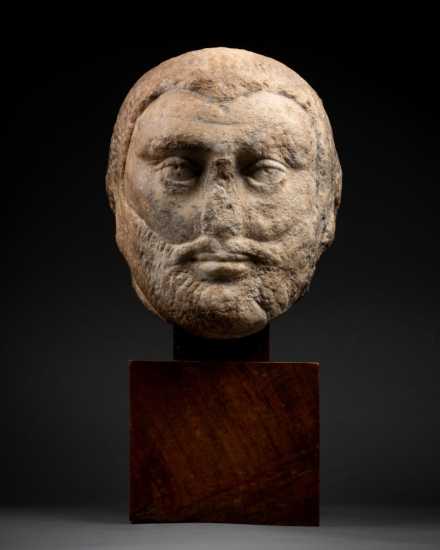
The marble head presented here belongs to a historically and stylistically significant strand of late antique portraiture, a field often difficult to interpret due to alterations over time. Despite uncertainties regarding the identity of the depicted figure, Tetrarchic portraiture provides stylistic clues that allow for informed hypotheses. The head is carved from large-grained white marble, possibly Parian, Proconnesian, or Lesbium, showing abrasion on the left side of the face and calcareous deposits suggesting prolonged exposure to water or humidity. Its opaque yellowish color, along with bluish veins, could indicate either the marble type or effects of combustion, while the missing nose reminds us of the fragility of such artifacts. The slightly below-natural-size head likely belonged to a complete statue, with an interlock at the neck suggesting it was attached to a body, though the precise original configuration is unknown. Stylistically, the short hair and full beard evoke early Tetrarchic fashion, reflecting the military and political aesthetics following the chaotic third-century period of civil wars. Comparisons with coins, busts, mosaics, and reliefs, such as those from Nicomedia, the Villa del Casale, and the Temple of Ammon, highlight similarities with known tetrarchs, particularly Maximian. Notable features include narrowed, philosophically weighted eyes and an archaic, symbolic smile, signaling calm authority and projecting the metaphysical power of the ruler. This smile, echoed in other Tetrarchic portraits, communicates stability and reassurance, aligning with the new imperial order established by Diocletian and his colleagues. Overall, the head exemplifies late antique artistry, combining formal elegance, political symbolism, and a rare window into the transitional period between Rome’s turbulent third century and the institutional consolidation of the early fourth century.
Bidding
No bids have yet been placed.